
The Power of Chelated Micronutrient Technology: The Role of EDDHA, EDTA, and DTPA in Modern Plant Nutrition
In modern agriculture, plants are exposed to increasingly demanding growing conditions—intensive production cycles, alkaline soils, climate-driven stress factors, and nutrient-poor environments. To achieve high productivity and consistent quality, crops rely not only on macronutrients such as nitrogen, phosphorus, and potassium, but also on essential micronutrients including iron (Fe), zinc (Zn), manganese (Mn), calcium (Ca), and magnesium (Mg).
However, under high-pH soils, calcareous environments, and intensive cultivation systems, these micronutrients become chemically bound in the soil and unavailable to the plant. As a result, growers experience problems such as chlorosis, stunted growth, reduced flowering, poor fruit set, and significant yield loss.
This is where chelated micronutrient technology emerges as one of the most effective solutions of modern plant nutrition. Pulcu Tarım’s product groups—formulated with EDDHA, EDTA, and DTPA chelating agents and offered in WG (Water Dispersible Granule), SC (Suspension Concentrate), and Micro Granule forms—provide unmatched bioavailability, solubility, stability, and root–leaf uptake efficiency in challenging soil conditions.
1. Why Chelation Technology Matters in Agriculture
Chelates are organic molecules that bind to metal ions and keep them in a stable, plant-available form. Without chelation, many micronutrients precipitate in the soil—especially under alkaline conditions—and become unusable by the plant.
Chelated formulations provide major advantages:
- They prevent micronutrient precipitation,
- Maintain element solubility across wide pH ranges,
- Increase plant uptake efficiency,
- Reduce leaching losses,
- Deliver faster physiological responses.
As highlighted in the Pulcu Tarım brochure, each chelating agent (EDDHA, EDTA, DTPA) has a unique stability profile, allowing the grower to select the most suitable option based on soil chemistry and crop needs.
2. Scientific Differences Between EDDHA, EDTA, and DTPA
➤ EDDHA — The Superior Chelate for High-pH Soils
EDDHA is the most powerful chelating agent for iron nutrition under calcareous and alkaline soils. Thanks to its stable ortho-ortho isomer structure (1.0–4.8 o-o), EDDHA maintains iron solubility even at pH 8–10, where other chelates lose effectiveness.
EDDHA SC formulations offer:
✔ Fast recovery from iron chlorosis
✔ High dispersion and stability
✔ Strong performance in orchards, vineyards, open-field vegetables, and high-pH soils
This makes EDDHA an indispensable tool for growers struggling with iron deficiency.
➤ EDTA — A Versatile Chelate for Multiple Micronutrients
EDTA is widely used for zinc, manganese, copper, calcium, and magnesium—thanks to its excellent solubility and compatibility with fertigation and foliar applications.
Advantages of EDTA include:
✔ Rapid dissolution in water
✔ Efficient foliar absorption
✔ Stability across moderate pH ranges
✔ Wide availability in single and mixed formulations
Pulcu Tarım’s brochure shows a rich EDTA product portfolio covering Mn, Zn, Cu, Ca, and Mg chelates to meet diverse crop demands.
➤ DTPA — Ideal for Slightly to Moderately Alkaline Soils
DTPA maintains strong iron stability in soils with pH 7.0–8.5, making it highly effective for many greenhouse and open-field conditions.
Available as:
- Liquid Fe %3.4
- Liquid Fe %6
- Powder Fe %11
DTPA is also compatible with hydroponic and fertigation systems, where clean, high-solubility solutions are essential.
3. Advanced Production Technologies: Nano, SC, and WG Formulas
Pulcu Tarım incorporates high-precision manufacturing technologies such as Spray Dry, Nano Chelation, and Nano Encapsulation, as highlighted on page 2 of the brochure.
These technologies deliver significant agronomic benefits:
✔ Nano-sized particles → Higher surface area → Faster absorption
Smaller particle size means more efficient root and leaf penetration.
✔ SC (Suspension Concentrate) → Homogeneous distribution & controlled release
- Reduced clogging in irrigation lines
- Stable suspensions with high reactivity
- Improved application efficiency
✔ WG (Water Dispersible Granule) → No dusting, rapid dispersion
Ideal for open-field and greenhouse applications where uniform distribution is crucial.
Overall, these technologies provide:
- Faster greening and chlorosis correction
- Improved flowering and fruit set
- Stronger vegetative growth
- Higher stress tolerance
- Greater yield and crop quality
4. Agronomic Benefits of Chelated Micronutrients
Scientific studies and global field data confirm the numerous advantages of chelated micronutrients:
• Rapid correction of iron chlorosis
EDDHA can visibly improve chlorophyll density within 3–7 days.
• Increased photosynthetic efficiency
Iron is fundamental for chlorophyll synthesis; deficiencies sharply reduce photosynthetic performance.
• Enhanced root development
Chelated elements penetrate root tissues more efficiently, promoting deeper, stronger root systems.
• Improved flowering, fruit setting, and uniformity
Chelated Zn, Mn, and Fe support hormonal balance and reproductive development.
• Higher yield and fruit quality
From color uniformity to shelf life, balanced micronutrient nutrition directly enhances commercial value.
• Stronger tolerance to abiotic stress
Chelated micronutrients help plants cope with drought, salinity, temperature stress, and rapid growth cycles.
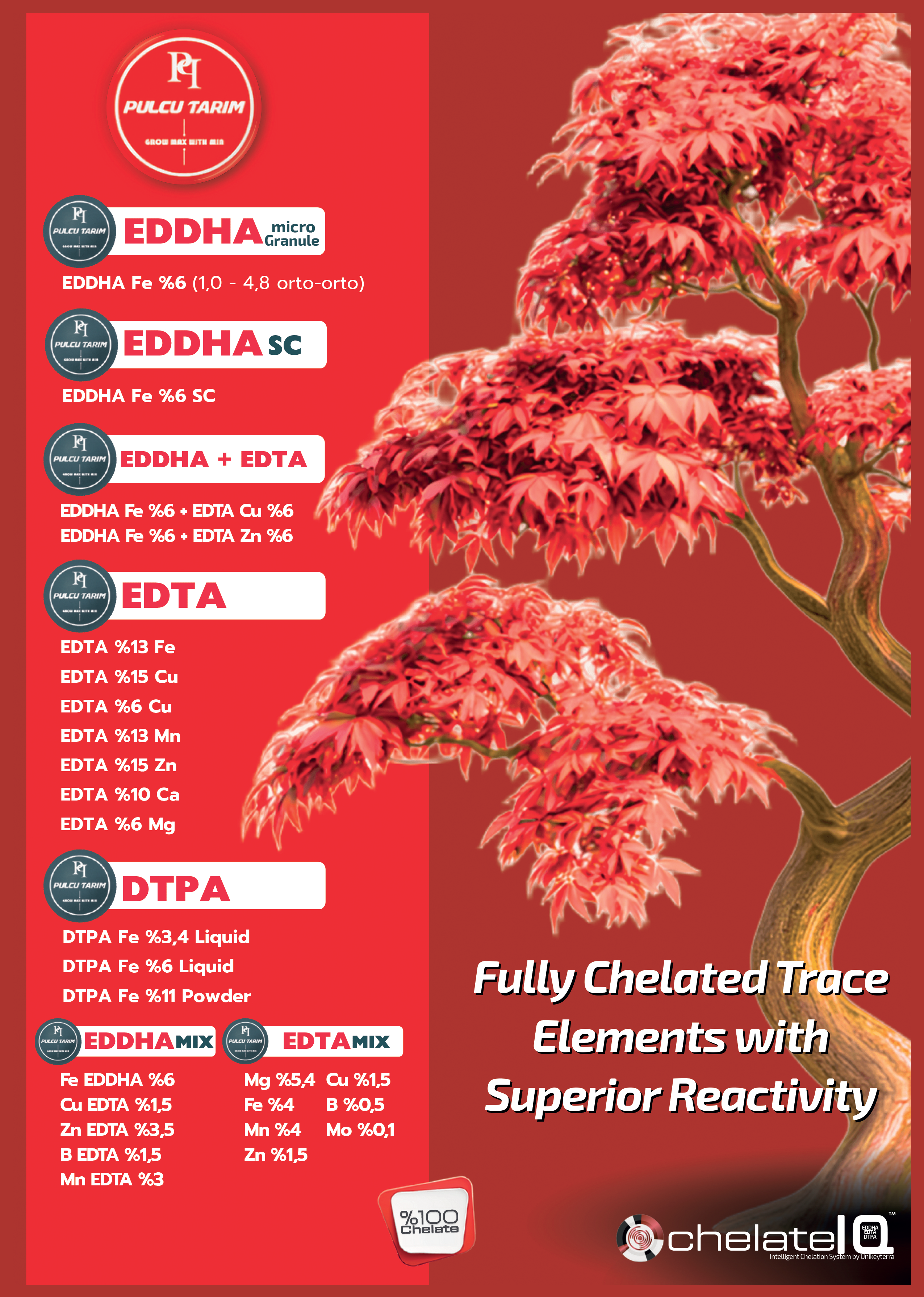
5. Pulcu Tarım’s Comprehensive Chelated Micronutrient Portfolio
- EDDHA Micro Granule – Fe 6% (1.0–4.8 o-o)
- EDDHA SC – Fe 6% Suspension Concentrate
- EDDHA + EDTA Mixes (Fe+Cu, Fe+Zn combinations)
- EDTA Chelates (Cu, Mn, Zn, Ca, Mg)
- DTPA Series (Fe 3.4% Liquid, Fe 6% Liquid, Fe 11% Powder)
- EDDHA MIX and EDTA MIX formulations
This broad product line ensures optimal solutions for orchard crops, greenhouses, vegetables, vineyards, field crops, and ornamental plants.
6. Chelated Micronutrients as the Future of Sustainable Agriculture
Sustainability in plant nutrition today means:
- Enhancing nutrient efficiency
- Reducing environmental losses
- Improving soil health
- Increasing tolerance to climatic stress
- Achieving more yield with fewer inputs
Chelated micronutrients support all these goals through:
✔ Higher availability at lower dosages
✔ Reduced nutrient fixation
✔ Greater plant uptake efficiency
✔ Environmentally friendly applications
✔ Stable performance across soil types
Pulcu Tarım’s advanced formulations align perfectly with the future vision of high-tech, sustainable agriculture.
Where Science Meets Agriculture
Pulcu Tarım combines chelation chemistry, nano-technology, and advanced production processes to deliver high-performance micronutrient solutions. These formulations ensure that essential elements—especially iron—remain available to the plant even under the most challenging soil conditions.
With faster uptake, greater efficiency, and superior plant response, chelated micronutrients are redefining the standards of modern plant nutrition.
The future of agriculture lies in precision, technology, and scientifically optimized plant nutrition—Pulcu Tarım continues to lead this transformation.